Together with Detective Sergeant Steve Shaw, I viewed the extensive damage to the nightclub and adjoining dining area on the tenth floor. The site was still too hot and dangerous for a close examination, so we made no attempt to enter it that evening.
Some 600 guests had been evacuated without injury. Our task was to establish how the fire had started and whether any criminal act was involved.
Hotel security chief Fred Beech, himself a former Bermuda police officer, helped arrange overnight protection of the scene, assisted by a uniformed officer. Shortly before midnight, I was formally appointed officer in charge of the investigation.
Scenes of Crime officers Detective Constables Roddy Barclay and Howard Cutts joined Fire Service investigators in a systematic examination of the tenth floor. A grid search was used to sift through the debris, examining the burned remains at floor, wall and ceiling levels. The work required patience and care: the destruction itself could conceal the evidence we needed.
Deputy Chief Fire Officer Michael “Mike” Doidge led the fire investigators. BELCO electrical inspector John “Johnny” Johnson and fireman Malcolm Johnson were also involved at the scene. Malcolm was then a trainee fireman; during the incident he spent time with the experienced visiting New York fire officer Tom Henderson, and later went on to become a senior Bermudian fire officer himself.
Heavy electrical wiring, cables, outlets and junction boxes serving appliances and large speakers in the severely damaged bar area were noted. Their presence was noted, but it was too early to draw conclusions.
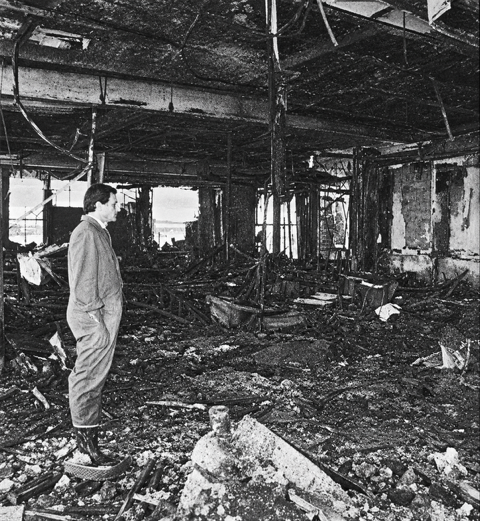
An important part of the examination was to establish whether the fire had begun in one place or at several separate points. The search identified a single seat of fire, with no secondary sites of ignition found. That finding was relevant to the question of deliberate ignition, although it did not, by itself, establish the cause.
At a press interview on Monday, I explained that we believed we had located the single area where the fire had started, but were still keeping an open mind. Forensic officers and the fire investigators working under Mike Doidge were continuing their examination. Witnesses had been interviewed and, at that stage, there was no evidence that the fire had been deliberately set.
I asked Johnny Johnson, a personal friend as well as a BELCO electrical inspector, to return and examine the appliances in and around the bar. The condition of the flooring immediately beneath the equipment supported the likelihood of an electrical fault.
There was also a striking piece of evidence clearly visible lying on the floor. The door of a fixed electrical distribution panel lay about fifteen feet directly out from its original wall position. At its centre was a hole the size of a man’s fist which should not have been there. I was told that the extreme heat and metal damage demonstrated on both the panel and the door itself was consistent with a powerful and severe electrical arcing event having occurred which had caused an explosion of power sufficient to dislodge the door from its panel and blow it across the room. Based on this evidence, conclusions were reached after which photographs of the panel and door were recorded by DC Cutts in my presence.
I was told that the extreme heat and metal damage to the panel and its door were consistent with severe electrical arcing, powerful enough to dislodge the door and blow it across the room. Howard Cutts photographed the panel and door in my presence.
These observations pointed towards an electrical cause, but the extent of the destruction would ultimately prevent the investigators from identifying the precise failure with certainty.
I also met overseas fire insurance assessors at the scene. A police spokesman subsequently announced that the forensic examination did not point to arson. A report would be submitted to the coroner.
Mr. Harrell said the trouble started when guests spotted smoke pouring out of the top floor of the building. “Everybody started to panic – people started pushing tables over, just trying to get out, rushing towards the elevators,” he said. “As we started to go through the side door, debris from the fire – the explosion up top – started to fall into the room. The people started to scream again, and they started to panic.”
With other staff, Harrell found another route through the St. George’s ballroom, using an emergency exit to the fifth floor. They continued down through the guest-room areas, knocking on doors to check that people were out.
Harrell’s reference to an “explosion up top” was of interest to me in light of the damage we had found at the electrical panel, although his account could not establish what had caused it.
Three grateful diners later wrote to The Royal Gazette praising his calm handling of the situation. Harrell later said that it was not until about one o’clock the following morning that he had time to reflect on what had happened. He paid tribute to colleagues, including off-duty staff who came in to help.
Managing director Bernard Guet commended Harrell and also singled out resident manager Michael Outerbridge and controller Michel Dombrowski, who had checked every bedroom to ensure that guests were safely evacuated.
Minister of Tourism the Hon. C.V. “Jim” Woolridge added his praise: “Mr. Guet, and his entire staff, from management right down, are all to be commended for their efforts.”
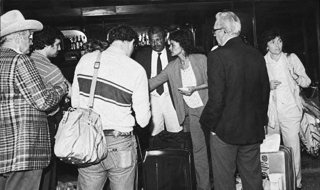
John Harvey, executive officer of the Bermuda Hotel Association and another former Bermuda police officer, helped management seek rooms for between 100 and 150 displaced guests. Almost everywhere was fully booked. Members of the community offered accommodation in their homes, while hotel staff worked to restore services for those who remained.
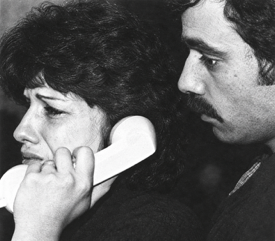
The difficulties had been were compounded when a party of 56 Apple Tours visitors arrived from the United States the next morning. A breakdown in communication had allowed them to travel despite the fire. With no accommodation available for the group elsewhere, most had to return home that day. Guet acknowledged the mistake, and Apple Tours director Ray Daley later promised full refunds.
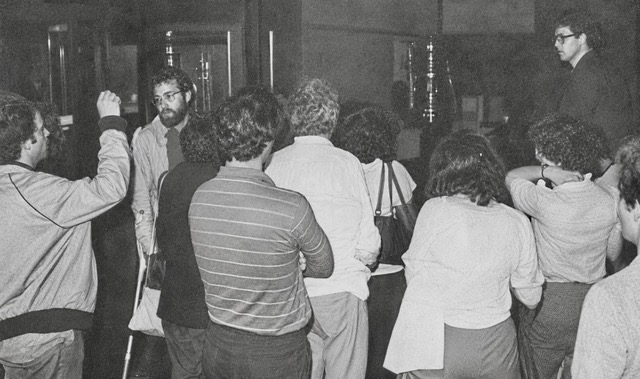
In comments published by the Mid-Ocean News, Henderson praised the Bermuda firefighters’ efforts but criticised the resources available and the time taken for equipment to arrive from Hamilton. He called for a full-time firefighting force in the East End and warned that a fire at night, or on a lower floor, could have had catastrophic consequences.
Henderson also raised concerns about the hotel’s precautions, including the absence of sprinklers, a broken firefighting standpipe and a faulty self-closing door to his room. Guet maintained that the hotel complied with Bermuda’s fire regulations and was regularly inspected.
In an editorial, Amanda Outerbridge supported the call for better East End protection. She reported that an hour had elapsed before firefighting equipment came fully into action and argued that St. George’s and the eastern parishes had as much right to protection as the rest of the Island.
The point was not a criticism of the courage of the firefighters at the scene. It concerned the provision of sufficient people and equipment close enough to respond quickly.
He praised the speed with which access to the hotel had been cordoned off and people turned away, reducing confusion during the emergency. He and Fred Beech gave particular thanks to Deputy Commissioner Harold Moniz and me for our help and dedication during the investigation.
Guet ended by expressing the hope that we might meet again under more cheerful circumstances.
Mike Doidge explained that a distribution panel and a step-down transformer above the seat of the fire had been too badly damaged to determine whether a mechanical breakdown had caused an electrical fault.
He told the inquest that the fire had started at 1.30 p.m., but the Fire Department had not been called until 3.05 p.m. It was under control by 5.07 p.m. and extinguished by 8 p.m. Collapsed internal partitions and a false timber floor had concealed pockets of fire which had to be dug out. The delay in notifying the Fire Department was a separate issue from the concerns about equipment travelling from Hamilton.
Doidge ruled out careless smoking because it did not fit the time factors and conditions at the point of origin. He also explained that the service bar lacked automatic heat or smoke detectors. Detectors in the adjacent kitchen had failed to signal the fire because their connecting wires had burned through. He recommended improved automatic alarm protection.
Detective Sergeant Steven Shaw confirmed that the fire had been confined to a non-residential area which was not in use at the time. Guests and staff had been evacuated without injury, and no guest’s personal property had been reported missing during the evacuation.
Howard Cutts told the court that all eight door-locks leading into and out of the bar area had been found secured. He had found nothing in the service area to suggest anything unlawful.
Johnny Johnson’s evidence retained the necessary qualification: an electrical fault was very likely, but the amount of damage meant that he could not say definitely that it had caused the fire.
Our investigation had found a single seat of fire, no secondary ignition sites and no evidence of an unlawful act. Although the exact electrical failure could not be established, the combined work of the police, Fire Service and BELCO had provided the coroner with the evidence on which to reach his conclusion.
_____________________________
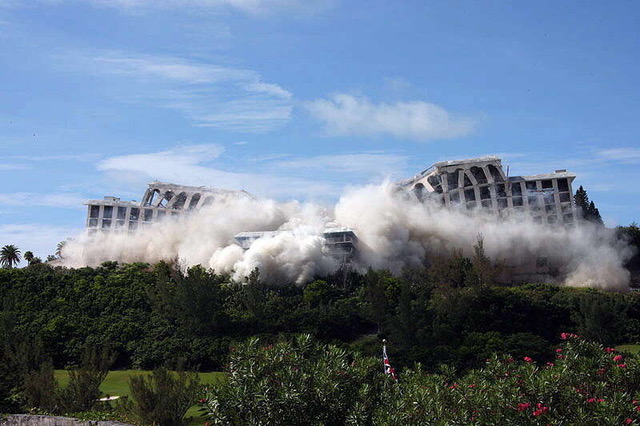
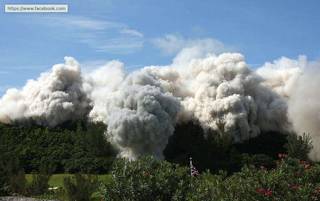
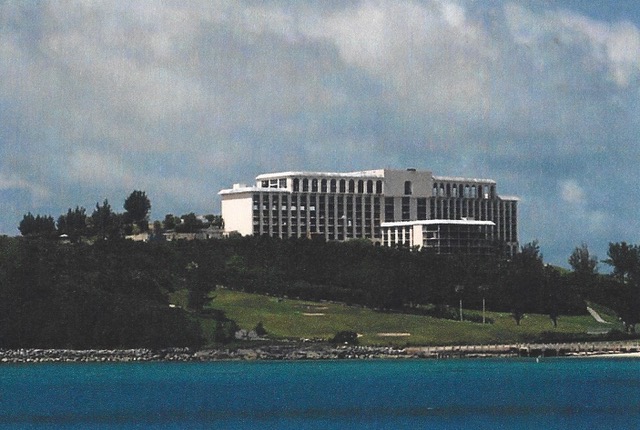
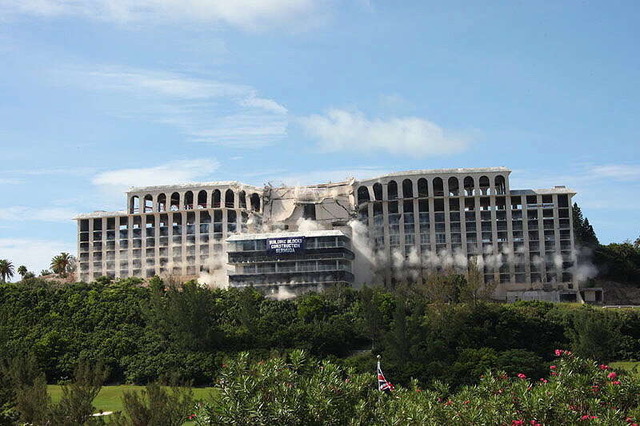
As can be seen in these photos below published by the Royal Gazette on 25th August 2008, the former St. George’s Hotel, Loews Hotel, and later Club Med Hotel which stood derelict for two decades, finally thundered to the ground at 10.20 a.m. today. The Royal Gazette reported as follows:-
"A huge blast signalled the Island’s first ever implosion and it took less than 15 seconds for the 28,000 tonnes of concrete to collapse in a massive pile of dust.
Hundreds of people came out to watch, film and photograph the historic event including on-lookers on scores of boats and jet-skis in the Narrows Channel.
Premier Ewart Brown and Works and Engineering Minister Derrick Burgess, who once worked at the hotel as a bartender, each pressed a button at Fort St. Catherine to start the implosion carried out by Demolition Dynamics, a subsidiary of US firm DH Griffin Wrecking Co.
One local resident Shorty Churm, whose green house on Naval Tanks Hill was one of the closest to the 11-storey structure, said he had mixed emotions. “It has not been maintained and it has just deteriorated. It used to be a great place and then all of a sudden it was an eyesore.”
Another resident who came to watch, Roderika Freeman, said: “That was so heart wrenching. I have very fond memories of that hotel.”
Dr. Brown said: “It felt great. There was a feeling of relief and it was just amazing to see the connection between a button and the building going down.”
 Going ....